

This whitepaper is a collaborative effort by the Propel Real Estate Capital team, representing views from
Propel Real Estate Capital and Stronghill Texas.
In commercial bridge lending, speed is decided before underwriting begins. Propel Real Estate Capital can close in as few as five days — but that clock starts from a complete file.1 The difference between a five-day close and a five-week stall is rarely the strength of the deal. It is the condition the file arrives in, and the way the people around it communicate.
Every lending team triages. When a submission arrives, the first internal question is not “do we like this?” It is “do we have enough to know whether this deserves scarce attention?” A file that clears that bar moves up the list. A file that needs multiple clarification loops before anyone can even assess it drops — no matter how good the underlying transaction might be.
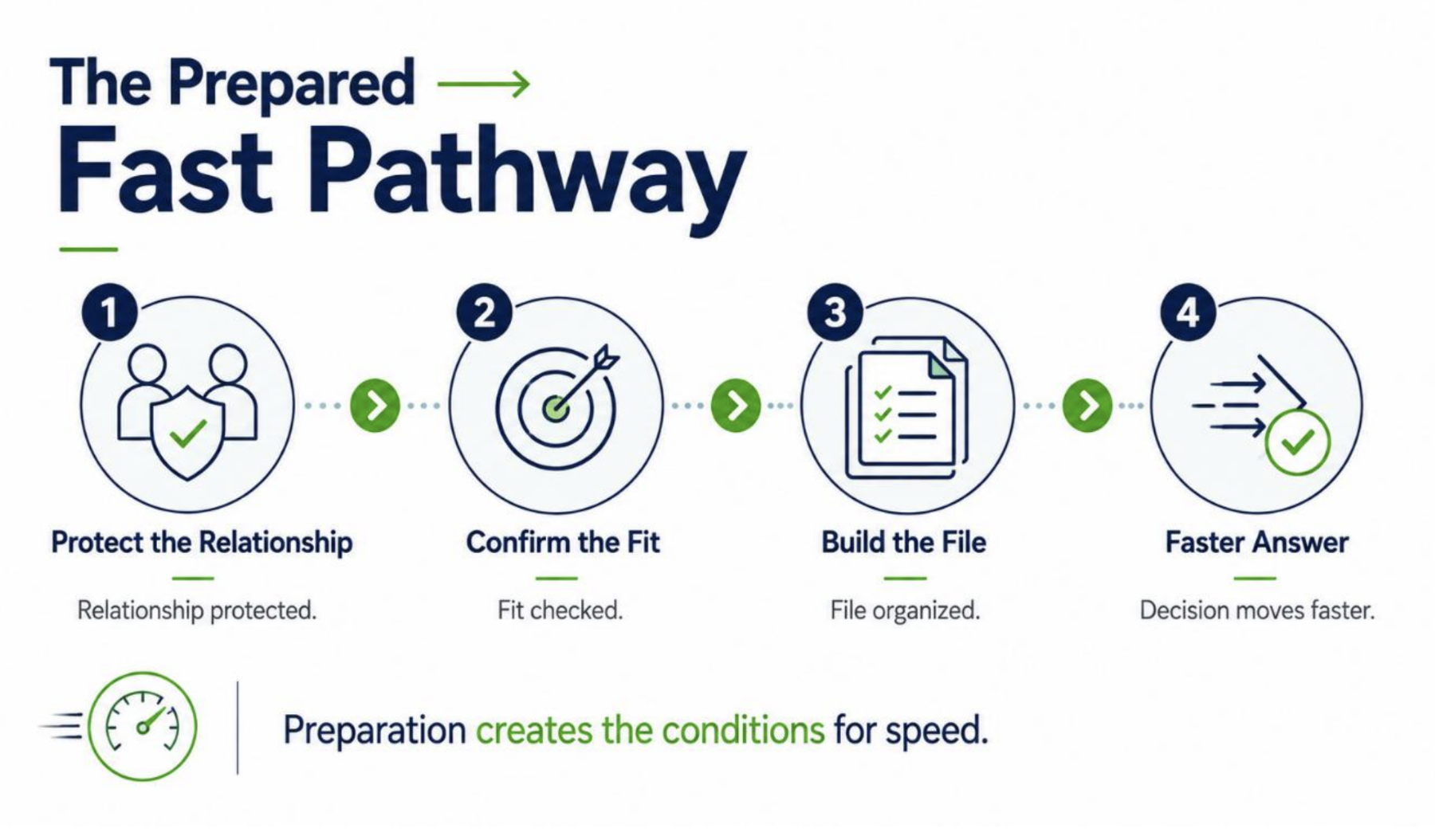
The brokers who consistently reach the front of the stack are not lucky, and they are not simply the ones with the cleanest credits. They are translators, expectation-setters, and relationship carriers who do three things with discipline: they protect the broker–borrower relationship inside a coordinated process, they test fit before anyone assembles a full package, and they submit files built for a decision rather than a document chase.
This paper covers those three disciplines in order — the partnership standard, the fit-first conversation, and the priority file — and equips each one with the working tools to run it: a role map, a call protocol, a six-question framework, a risk playbook, worksheets, templates, and a readiness scorecard a broker can put into the very next submission.
Closing timelines assume a complete file. Every transaction remains subject to Propel Real Estate Capital’s transaction- specific review.
The partnership standard: protect the relationship, verify the facts
Broker-friendly is an operating model, not a slogan. The broker remains the relationship lead, the source of context, and an active participant from introduction to closing. At the same time, closing responsibly requires factual clarity — the borrower’s story, the collateral, the use of funds, and the exit, confirmed at the source. A sound process delivers both. Three beliefs get in the way:
- Belief: “A direct lender–borrower conversation means the broker is being cut out.” In practice: A direct factual call is a coordinated operating step, not a change in who owns the relationship. The broker leads the introduction, sets expectations, and stays visible in material communication. Facts are clarified with the broker, not around the broker.
- Belief: “Once the file is submitted, the broker’s job is done.”
In practice: Roles stay explicit through closing: the broker owns the relationship, the borrower owns the facts, and Propel owns the credit decision. Every substantive conversation ends with a written recap — what is missing, who owns it, and when it is due — so no one reconstructs a phone call from memory. - Belief: “Role and fee conversations can wait until closing.”
In practice: The broker’s role and fee are disclosed early, and broker participation is acknowledged openly. Any transaction-specific arrangement is documented rather than assumed — which is exactly how surprises are prevented on both sides of the table.
The payoff is cumulative. A sound process makes the current transaction progress and the next one easier to start, because trust is built through consistent behavior rather than a one- time application. The three exhibits that follow turn the standard into an operating system: who owns what at each moment, how the coordinated call runs, and which behaviors move files — or stall them.
Exhibit 1
Most friction in brokered deals is not bad faith. It is unassigned work.
Who owns what at each moment of the transaction — and the written output that closes each loop
| MOMENT | BROKER OWNS / BORROWER / SPONSOR OWNS | PROPEL OWNS |
|---|---|---|
| Initial fit | Transaction context; relationship lead; a specific ask | Accurate facts; authority to discuss the opportunity |
| Preliminary fit | Questions; requested next step | Fit response or short missing-item list |
| Joint factual call | Introduction; participation; expectation setting | First-hand answers on sponsor, collateral, uses, timing, and exit |
| Underwriting follow-up | Keep the borrower engaged; consolidate updates; flag changes | Documents and prompt explanations |
| Credit review | Vendor and closing coordination | Updated status and the next decision point |
| Decision / next step | Communicate with the borrower; confirm expectations | Confirm acceptance, conditions, or withdrawal |
| Decision and action plan | Shared with the broker (and borrower / sponsor) | Proceed, structure differently, request more information, or decline |
A useful rule: the broker owns the relationship, the borrower owns the facts, and Propel owns the credit decision. The written recap connects all three.
Material facts and next steps should not live in separate inboxes. The broker is copied or included as appropriate, and a shared recap goes out whenever facts, responsibilities, or timing change.
Exhibit 2
A direct call is not an end-run. It is a controlled step with a written finish.
The broker-protected factual call, in three moves
| STEP | WHAT HAPPENS | WHY IT MATTERS |
|---|---|---|
| 1. Broker-led introduction | The broker states the purpose, identifies the participants, confirms the broker’s role, and sets communication expectations — on the record. | The relationship is acknowledged explicitly before any factual question is asked. |
| 2. Joint factual discussion | Propel confirms the facts directly with the borrower — sponsor, property, request, sources and uses, timing, repayment path, and known issues — with the broker included as agreed. | First-hand answers replace the telephone game; credit, processing, and closing work from one clean record. |
| 3. Written recap | Everyone receives the same list: missing items, the owner of each one, the due date, and the next decision Propel will make after receipt. | Momentum is protected on both sides; no one reconstructs a call from memory. |
IN THE FIELD: HOW THE CALL OPENS
The broker: “Propel will use this call to confirm transaction facts and identify the next underwriting step. I will remain involved throughout, and material follow-up will stay broker-visible.”
Propel: “Understood. We will keep the broker included, focus the discussion on the transaction, and send written next steps after the call.”
End with a decision point: state what Propel expects to decide once the listed items arrive — preliminary fit, revised structure, a term discussion, additional review, or a decline.